


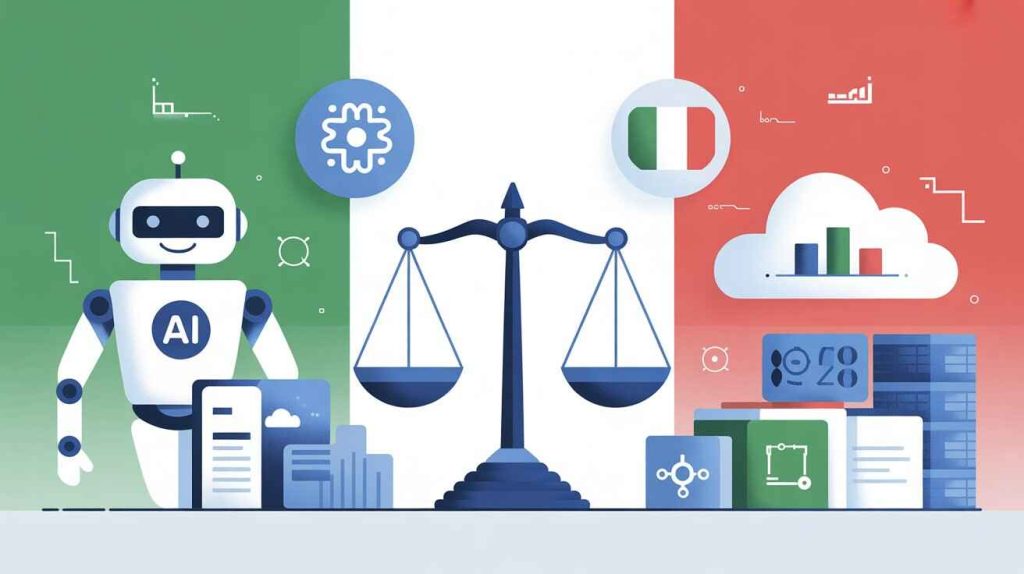
Artificial Intelligence is moving fast. Governments around the world are rushing to regulate it. In September 2025, Italy passed a new AI law that aligns closely with the European Union’s AI Act. This law sets out how AI can be used, what rules companies must follow, and what penalties apply if the rules are broken.
The Italy AI law is one of the most detailed frameworks in Europe. It covers transparency, oversight, children’s protection, workplace use, healthcare applications, and education standards. It also introduces strong penalties for misuse, with jail time of up to five years in extreme cases.
This is not just another regulation. It marks a turning point in how AI will be controlled in Europe and beyond. For businesses, startups, and AI tool makers, this law will shape product development, compliance costs, and how AI is offered to users. For citizens, it sets new protections against misuse and harmful applications.
Why Italy AI Law Matters
Italy is not the first country to regulate AI, but the way it has done so is important for three main reasons:
-
Alignment with the EU AI Act – Italy’s law mirrors much of the European framework but adds stricter rules in certain sectors like healthcare and education.
-
Clear penalties – Unlike vague guidelines, Italy enforces concrete punishments, including prison sentences for severe misuse of AI.
-
Practical focus – The law deals with real-world issues like children using AI, workplace monitoring, and AI’s role in medical decision-making.
This makes Italy’s AI law not just a copy of the EU AI Act but a model for how national governments can adapt European rules to local needs.
Key Features of Italy’s AI Law
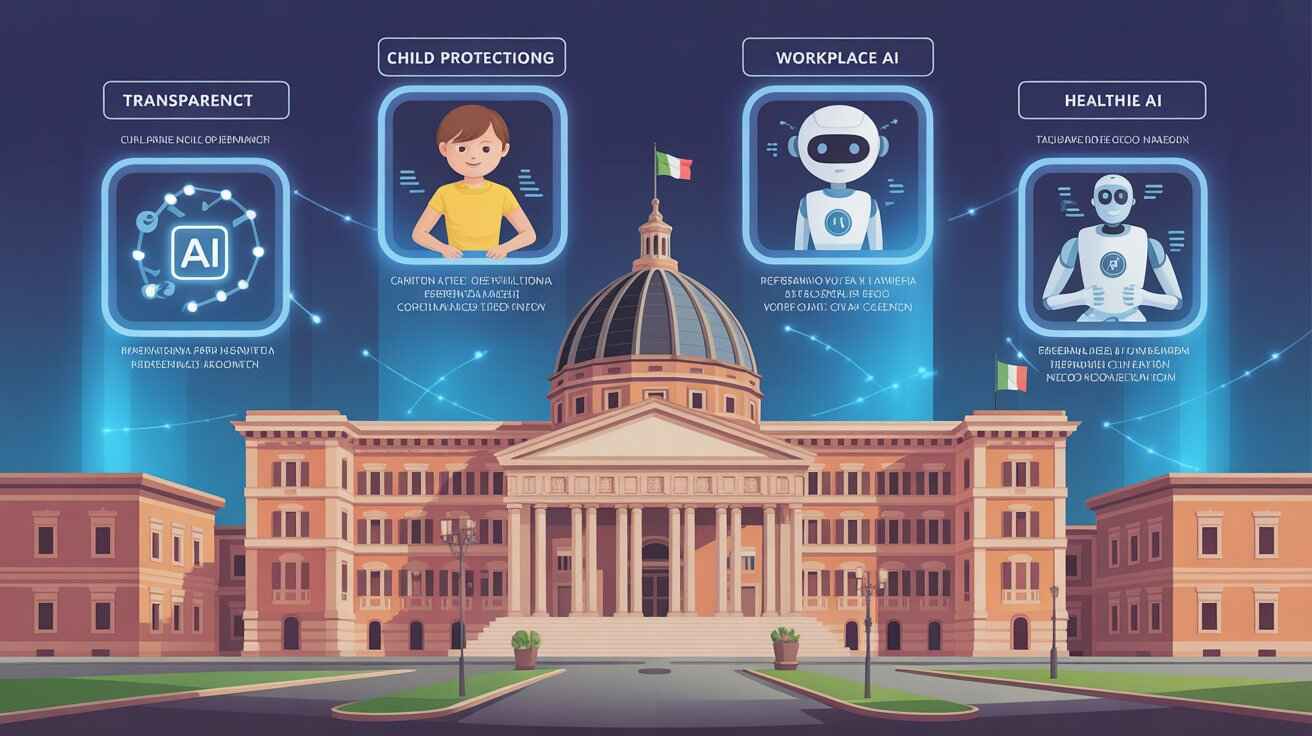

1. Oversight and Regulation
Italy has created a National AI Oversight Authority. This body will:
-
Monitor AI deployments across industries.
-
Approve or reject high-risk AI applications.
-
Ensure companies follow transparency and safety rules.
-
Handle complaints from citizens and organizations.
This makes Italy one of the first countries to establish a dedicated authority for AI monitoring.
2. Transparency Rules
AI tools must clearly disclose when users are interacting with artificial intelligence. For example:
-
Chatbots must say they are AI, not humans.
-
AI-generated images or videos must carry a watermark or label.
-
Companies must provide documentation on how AI systems work, what data they use, and what risks are involved.
The aim is to avoid hidden AI interactions that can trick or mislead people.
3. Protection for Children
One of the most talked-about parts of the law is its protection for minors under 14 years old.
-
Children cannot use certain AI tools without parental approval.
-
Schools must ensure AI-assisted learning tools are safe, transparent, and age-appropriate.
-
Companies face heavy fines if they knowingly provide unsafe AI services to under-14 users.
This is a strong step compared to other countries, where child safety in AI is often overlooked.
4. AI in Workplaces
Employers must be transparent about using AI to monitor staff. For example:
-
If AI tracks employee performance or productivity, workers must be informed.
-
AI cannot make final decisions about hiring or firing without human review.
-
Stronger worker rights are included to protect against algorithmic bias.
This prevents companies from secretly using AI surveillance in ways that could exploit workers.
5. AI in Healthcare
Healthcare is one of the most sensitive areas for AI. Italy’s law requires:
-
AI medical tools to be approved by regulators before use.
-
Human doctors to always make the final decision in diagnosis and treatment.
-
Strong data protection rules for patient information.
This ensures AI supports healthcare, but never fully replaces human oversight.
6. Penalties and Enforcement
Perhaps the strongest part of Italy’s law is its penalty system.
-
Minor violations: Heavy fines.
-
Serious violations: Ban on AI system use.
-
Severe misuse (such as using AI for fraud, manipulation, or harm): Up to 5 years in prison.
This strict enforcement shows that Italy is serious about keeping AI safe and ethical.
Impact on Businesses and Startups

The new law has a direct effect on companies working with AI in Italy.
a) Higher Compliance Costs
Businesses must now invest in compliance systems. For example:
-
Documentation of how AI models are trained.
-
Regular audits to prove transparency.
-
Risk assessments before releasing AI tools.
This may be expensive for startups and small businesses. Larger companies may adapt more easily since they already have compliance teams.
b) New Market Opportunities
At the same time, the law creates new opportunities. Companies that can:
-
Build “ethical AI” solutions.
-
Provide compliance software.
-
Develop secure, transparent models.
…will be in demand as other firms need help meeting the rules.
c) Stricter AI Product Launches
Startups will need government approval before launching high-risk AI products, such as healthcare apps, workplace monitoring tools, or education systems. This slows down releases but ensures safer deployment.
In short: businesses face challenges but also a new market for compliant AI solutions.
Impact on AI Tool Makers
Tool developers, including global players like OpenAI, Google, and Anthropic, must adapt to Italy’s framework.
-
Chatbots must include disclosure labels (“This is AI-generated”).
-
Image & video generators must embed watermarks.
-
Educational AI apps must provide age filters.
-
Healthcare AI tools require clinical validation.
For AI tool makers, Italy becomes a test ground. If they can comply here, they can likely meet EU-wide standards once the EU AI Act takes full effect.
Education and the AI Law

Education is one of the areas where AI has grown fastest. Italy’s law addresses this directly.
1) Safer AI for Students
Schools using AI apps for homework help, tutoring, or classroom tools must verify that the systems are:
-
Age-appropriate.
-
Transparent in how answers are generated.
-
Free from manipulative or biased content.
This means that AI tools marketed to students in Italy will be under strict review.
2) Teacher’s Role Stays Central
AI cannot replace teachers. The law requires that teachers remain responsible for evaluating students, even if AI is used to support learning.
This ensures that AI becomes a support tool, not a substitute for educators.
Civil Liberties and Citizen Protection
AI has the power to track people, influence opinions, and even manipulate behavior. Italy’s law introduces protections for citizens.
-
Ban on hidden AI surveillance – Companies cannot secretly track users with AI.
-
Right to appeal AI decisions – If an AI system rejects a loan or job application, users can demand a human review.
-
Bias protections – AI must be tested for fairness, especially in areas like hiring, housing, and education.
These rules are designed to protect civil rights in an era where AI is becoming deeply embedded in daily life.
Global Comparisons
How does Italy’s law compare to other regions?
1. United States
The U.S. does not yet have a nationwide AI law. Regulations are mostly left to states, with some federal guidelines. Compared to Italy, the U.S. is more industry-led and less strict.
2. China
China heavily regulates AI but in a different way. Its rules focus on content control and political alignment. Italy’s focus is more on ethics, safety, and individual rights.
2. Other EU Countries
Italy is ahead of many EU members by already implementing a national AI law aligned with the EU AI Act. France, Germany, and Spain are still preparing similar laws.
This makes Italy an early mover within the EU and a model for others.
The Future of AI Regulation in Europe
Italy’s new AI law is not happening in isolation. The entire European Union is moving toward stricter AI oversight through the EU AI Act. Italy’s law shows how member states may go beyond EU requirements, adding local safeguards.
This trend suggests that:
-
Businesses will face a patchwork of national variations on top of EU-wide rules.
-
Countries may compete on who has the most trusted AI framework, attracting ethical AI companies.
-
Users may gain more confidence in AI if regulations are strong and clear.
The future likely holds more alignment between national laws, but Italy has set the tone by being bold and early.
Reactions from Industry Experts
The new law has sparked strong reactions from across the AI landscape.
1. Supporters
Many civil rights groups and education advocates welcome the law. They believe it:
-
Protects children from unsafe tools.
-
Stops companies from misusing AI surveillance.
-
Creates accountability for high-risk systems.
Healthcare organizations also support the human oversight rule, ensuring that AI does not replace doctors.
2. Critics
On the other hand, business associations worry about:
-
High compliance costs for startups.
-
Slower innovation due to approval requirements.
-
Risk of driving AI research to countries with lighter rules.
Some AI developers fear Italy’s penalties may discourage experimentation.
Voices from Citizens
Public opinion in Italy is mixed but leaning positive.
-
Parents appreciate the under-14 restrictions, seeing them as necessary in the age of TikTok, ChatGPT, and generative AI.
-
Workers welcome transparency about workplace monitoring.
-
Students are excited about AI but cautious about limits in education.
Overall, the law seems to be increasing trust in AI, even if it raises concerns about freedom to innovate.
The Bigger Picture: AI Laws Shaping the World
Italy’s step reflects a global trend: AI is too powerful to remain unregulated. Countries are moving from “wait and see” to “set clear rules.”
-
The U.S. is experimenting with executive orders and state laws.
-
China enforces heavy controls but focuses on political narratives.
-
Italy and the EU are focusing on ethics, safety, and transparency.
This signals the birth of a new era: AI will grow, but under strict legal and ethical frameworks. Companies that adapt will thrive, while those ignoring the rules will struggle.
Also Read
OpenAI Partners with Broadcom to Mass-Produce AI Chips
Can AI Suffer? Exploring Ethics & Sentience in Artificial Intelligence
Conclusion
Italy’s AI law is more than a regulation. It is a statement of intent. It shows that AI must serve society safely, transparently, and responsibly.
For businesses, it means higher compliance but also new opportunities. For citizens, it promises more protection and fairness. For the world, it is a signal that AI laws are no longer optional—they are the future.
As one of the first countries to move ahead of the EU AI Act, Italy has positioned itself as a leader in AI governance. The global AI community will be watching closely to see how this law works in practice, and whether other nations will follow its example.