


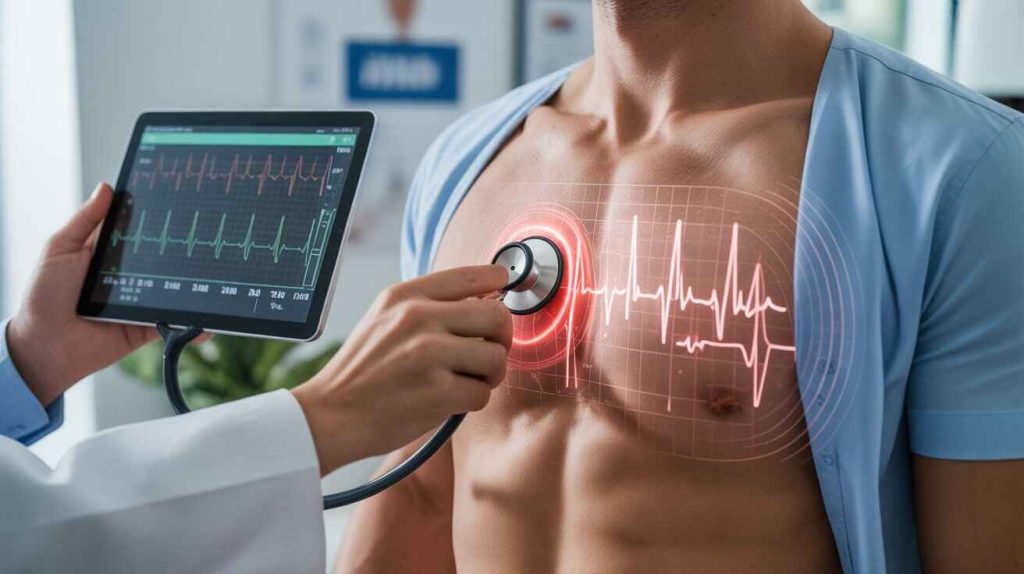
A groundbreaking AI-powered stethoscope developed by Imperial College London and Imperial College Healthcare NHS Trust is set to transform heart disease detection. The device can detect serious conditions such as heart failure, atrial fibrillation, and heart valve disease in as little as 15 seconds during routine checkups.
Traditionally, diagnosing these heart conditions requires multiple tests, including electrocardiograms (ECG), echocardiograms, and specialist evaluations. This AI stethoscope integrates traditional auscultation, ECG recording, and machine learning algorithms to provide rapid, accurate results, potentially saving lives by enabling early intervention.
How the AI Stethoscope Works
Unlike conventional stethoscopes, this AI-enabled device is equipped with a single-lead ECG sensor and a high-precision microphone array. When placed on a patient’s chest, it captures:
-
Phonocardiogram (PCG) signals: The sound of the heartbeat.
-
Electrical activity of the heart: Through the ECG sensor.
-
Blood flow patterns: Subtle variations that indicate abnormalities.
All data is transmitted via Bluetooth to a smartphone or tablet. Advanced AI algorithms analyze the signals in real time and generate a diagnostic report within 15 seconds. These insights can flag conditions that might otherwise go undetected in standard checkups.
Real-World Study: TRICORDER Trial
The AI stethoscope was evaluated in the TRICORDER study, one of the largest trials of its kind:
-
Participants: 12,700 patients across 200 GP clinics in the UK.
-
Coverage: Approximately 1.5 million patients collectively.
-
Results:
| Condition | Detection Increase |
|---|---|
| Heart Failure | 2× more likely |
| Atrial Fibrillation | 3.5× more likely |
| Heart Valve Disease | 2× more likely |
These results demonstrate the AI stethoscope’s ability to significantly improve diagnostic accuracy, particularly for symptomatic patients. Early detection enables timely treatment, reducing the risk of strokes, hospitalizations, and other complications.
Why Early Detection Matters
Heart disease is the leading cause of death worldwide, according to the World Health Organization. Early identification of heart conditions can:
-
Prevent hospitalizations due to advanced heart failure.
-
Reduce the risk of stroke caused by untreated atrial fibrillation.
-
Stop the progression of silent heart valve diseases before serious complications occur.
With this AI device, GP clinics can become early detection hubs, even in areas without immediate access to cardiologists.
Expert Opinions

Supportive Voices:
-
Professor Nicholas Peters, Imperial College London:
“Integrating AI with the stethoscope has modernized one of medicine’s oldest tools. It gives doctors a powerful way to detect heart conditions quickly, often before patients even notice symptoms.”
-
British Heart Foundation (BHF):
“Early diagnosis is key. Devices like this can help more patients access treatment sooner, improving their quality of life.”
Cautionary Voices:
-
Dr. Sarah Clarke, Royal College of Physicians:
“AI tools are promising, but they should support—not replace—clinical judgment. False positives are a concern and must be managed carefully.”
Despite the device’s potential, 70% of clinicians stopped using it within a year, citing workflow challenges and data management concerns.
Challenges and Limitations
Even with promising results, several limitations remain:
-
False Positives: About two-thirds of patients flagged for heart failure were later found not to have the condition, highlighting the need for follow-up testing.
-
Workflow Integration: GPs found it difficult to incorporate the device into standard practices, especially since it requires smartphone connectivity and cloud-based data analysis.
-
Not a Screening Tool for Healthy Individuals: Experts recommend its use primarily for symptomatic patients.
-
Data Privacy: Patient heart data is sensitive, and the system must comply with data protection regulations to ensure confidentiality.
Real-World Patient Impact
During the trial, the AI stethoscope led to life-saving diagnoses:
-
Case 1: A 52-year-old man with mild shortness of breath was diagnosed with early-stage heart failure, allowing for immediate medication and lifestyle changes.
-
Case 2: A 67-year-old woman experiencing occasional dizziness was found to have atrial fibrillation, enabling her to start treatment that significantly lowered her stroke risk.
These examples show how early detection through AI can change patient outcomes dramatically.
Future Prospects
Researchers are now focused on:
-
Improving accuracy to reduce false positives.
-
Making the device more user-friendly and easier to integrate into clinic workflows.
-
Connecting with electronic health records (EHRs) for seamless data transfer.
-
Developing wearable versions for continuous home monitoring.
Wider adoption could save thousands of lives annually and reduce healthcare costs by minimizing unnecessary tests and hospital admissions.
AI in the Broader Medical Landscape
The AI stethoscope is part of a growing trend of AI-driven healthcare solutions:
-
Medical imaging: AI aids in early detection of cancers and lung diseases.
-
Telemedicine: AI chatbots help triage patients and offer preliminary advice.
-
Surgery: AI-guided robots improve precision in complex operations.
These innovations illustrate how AI can enhance clinical expertise, rather than replace it, making healthcare faster, more accurate, and more accessible.
Conclusion
The AI stethoscope represents a milestone in modern medicine. By combining a centuries-old diagnostic tool with cutting-edge artificial intelligence, it enables rapid detection of heart conditions, providing actionable insights in just 15 seconds.
While challenges such as false positives and workflow integration remain, the potential benefits are substantial. Early detection, faster intervention, and improved patient outcomes could make this device an essential tool for primary care and cardiology worldwide.
“If the traditional stethoscope symbolized medicine for centuries, the AI stethoscope could become the symbol of modern, tech-enhanced healthcare,” says Professor Peters.
With ongoing improvements, training, and wider adoption, AI-powered stethoscopes could redefine the future of heart disease diagnosis.