

NASA has taken another giant leap in space exploration, but this time it isn’t a rocket launch that’s making headlines—it’s artificial intelligence. The agency has revealed a groundbreaking satellite technology that uses AI to decide what images to capture while orbiting Earth.
This new advancement could completely transform how space missions are run. Instead of relying on scientists to send instructions from the ground, the satellite itself will have the intelligence to recognize, analyze, and capture important events in real-time.
From natural disasters to climate changes, this AI-powered system may provide faster, smarter, and more precise data for scientists. It’s almost like having a digital astronaut in space—working 24/7 without human intervention.
Why NASA Is Using AI in Satellites
Traditional satellites capture thousands of images daily, but not all of them are useful. Many photos are repetitive, showing clouds, empty oceans, or areas with little scientific interest. These irrelevant images take up precious storage space and slow down data analysis.
AI changes that. By teaching satellites how to “think,” NASA ensures they only capture important, high-value information. For example:
-
Detecting wildfires in real-time – AI can spot smoke patterns and capture images instantly.
-
Tracking hurricanes and storms – Instead of waiting for commands, the satellite can focus on changing weather systems.
-
Observing deforestation or ice melting – The AI can recognize long-term patterns and take meaningful snapshots.
This not only saves time but also reduces the amount of wasted storage and bandwidth needed to transmit useless images back to Earth.
How the AI Satellite Works
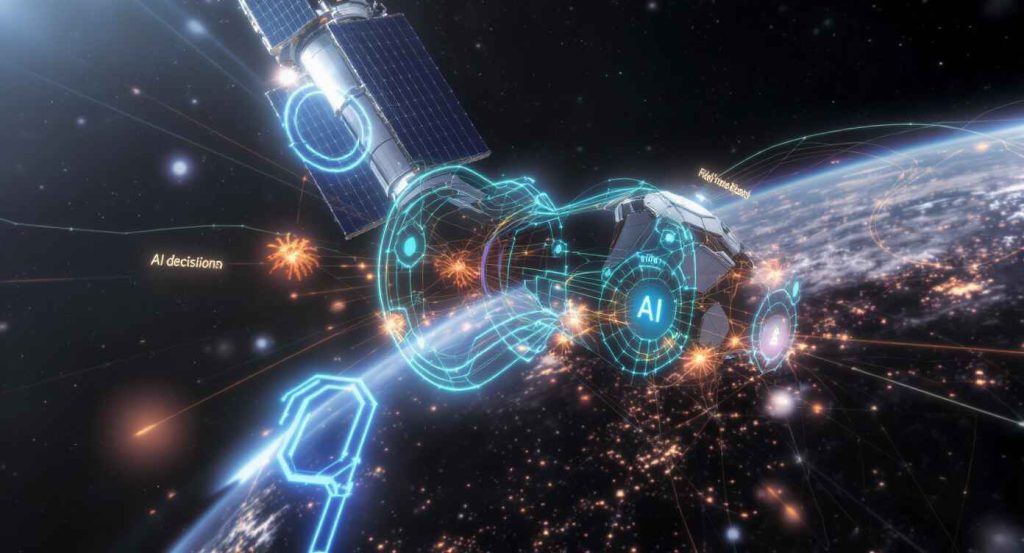
The new AI system is equipped with machine learning algorithms trained on years of Earth observation data. It has the ability to:
-
Identify Objects & Events – AI can recognize forests, cities, oceans, clouds, and even man-made structures.
-
Prioritize Captures – Instead of random shots, it chooses high-priority events like wildfires or flooding.
-
Self-Learn Over Time – The satellite improves its decision-making as it gathers more data.
NASA describes it as a “smart filter in space” that decides what is worth seeing. Instead of sending all images to Earth for scientists to sort, the AI satellite does the sorting itself.
Real-World Applications of NASA’s AI Satellite
This technology isn’t just futuristic—it has immediate, real-world benefits:
-
Disaster Response – During wildfires, earthquakes, or floods, AI satellites can send critical images faster to emergency teams.
-
Climate Change Monitoring – Tracking melting glaciers, rising sea levels, and changing ecosystems becomes more efficient.
-
Space Exploration – AI can also be applied to missions beyond Earth, such as monitoring Mars or distant moons.
-
Military & Security Uses – Governments may use AI satellites for border monitoring or defense intelligence.
NASA stresses that its primary goal is scientific discovery and global safety, but the possibilities go far beyond research.
What Makes This Update Different from Past Satellites?
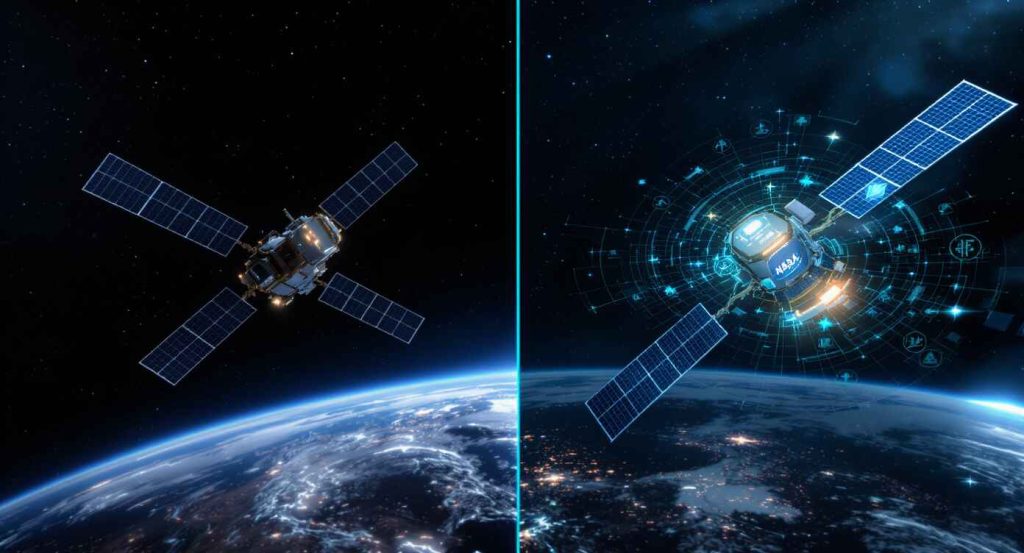
While previous satellites relied on pre-programmed instructions, NASA’s AI-driven model is autonomous. This means it doesn’t need to wait for commands from Earth—it makes decisions on the spot.
For example, a traditional satellite might be told to photograph California every 24 hours. But if a wildfire suddenly breaks out, the old system would miss it until the next scheduled capture. The new AI-powered satellite, however, would immediately detect smoke, capture the event, and alert scientists in real time.
This is a huge shift in how data is collected and used.
Expert Opinions on NASA’s AI Satellite
Scientists and AI experts are calling this a major step forward.
-
Dr. Karen St. Germain, NASA’s Earth Science Division Director, said:
“AI satellites will allow us to see our planet in ways we’ve never been able to before. They will capture events as they happen, giving us real-time insights into Earth’s changes.” -
AI Researcher Dr. Ethan White added:
“This is like giving satellites a brain. They’re no longer blind cameras in space—they’re intelligent observers.”
Challenges and Concerns
Of course, using AI in space raises some challenges:
-
Accuracy – What if the AI misses important events?
-
Bias in Data – AI only learns from the data it’s trained on, so it might overlook new patterns.
-
Autonomy Risks – Some experts worry about giving satellites too much control.
-
Ethics – How will data be shared, and who controls access to these powerful tools?
NASA is addressing these issues by combining AI autonomy with human oversight. Scientists will still review data and correct mistakes, ensuring the AI improves over time.
Future of AI in Space Exploration
This satellite is just the beginning. NASA plans to expand AI use across different missions:
-
Mars Rovers – AI could allow rovers to explore terrain without waiting for Earth commands.
-
Space Telescopes – AI could help telescopes focus on important cosmic events like supernovas.
-
Deep Space Missions – Future spacecraft may make independent decisions when communication delays are too long.
The combination of AI and space exploration could lead to faster discoveries, more efficient missions, and possibly even autonomous colonization efforts in the future.
Also Read
NASA and IBM Launch ‘Surya’: A Revolutionary AI Model to Predict Solar Storms
NASA and Google Launch AI Medical Assistant for Space Missions
Conclusion
NASA’s AI-powered satellite represents a turning point in space research. By giving satellites the ability to decide what to capture, scientists can focus on the most valuable data. This has implications for climate change monitoring, disaster response, and even future space missions.
It’s truly “out of this world”—AI is no longer just helping us on Earth, but in orbit, and soon, across the universe.